Printer preflight
How to prepare tattoo stencils for a thermal printer
A clean file can still produce a poor transfer. Check line weight, orientation, scale, paper, and printer behavior before the final pass.
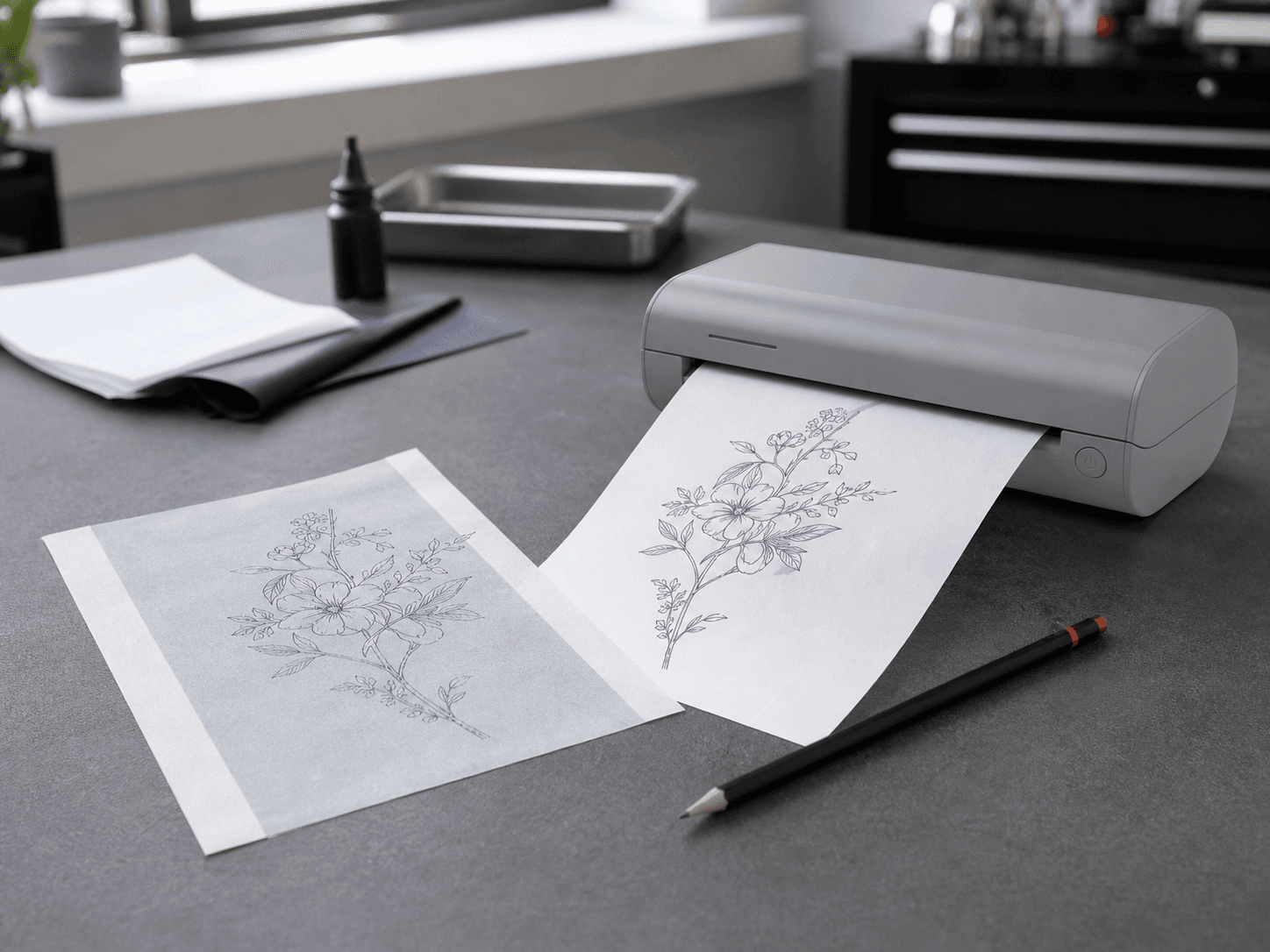
Use decisive black lines
Thermal transfer systems respond more reliably to strong, continuous marks than to pale gray edges. Review thin contours at the intended output size. Increase ink strength when important boundaries are too light, but avoid making dense areas merge into solid blocks.
Mirror only when the workflow requires it
Whether a file should be mirrored depends on the printer, driver, carrier path, and transfer method. Mark the intended orientation on a test shape or word, print it once, and verify the result. Do not rely on memory when switching between devices or workflows.
Set scale before printing
Confirm the physical dimensions of the design and the printable area of the paper. Watch for automatic fit-to-page settings that silently resize the image. Keep enough margin for the carrier sheet and feed direction without shrinking the stencil more than intended.
Five-point preflight
- Confirm the final crop and orientation.
- Check the thinnest lines at output size.
- Verify mirror behavior with the current printer path.
- Confirm physical dimensions and page scaling.
- Run a small test before the final sheet.
Expect printer-specific variation
Heat, battery state, print speed, transfer paper, carrier sheets, and maintenance can all affect the result. The same PNG may print differently across two devices. Keep a known-good test design and record the settings that work for each station.
Inspect the transfer, not only the print
The paper output is an intermediate result. Check whether the final transfer preserves small gaps, joins broken contours, or picks up unwanted texture. Adjust the digital linework only after separating file problems from printer or application problems.